NNAIRE
Glossary
DNA
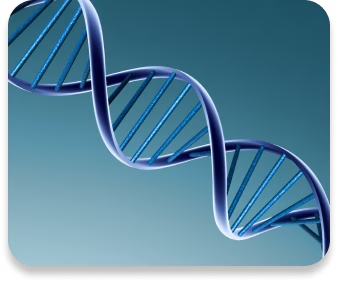
Molecule containing hereditary genetic information. Its double helix structure was discovered thanks to the pioneering work of Rosalind Franklin.
Abstract Algebra
Branch of mathematics that studies algebraic structures (groups, rings, fields, etc.) independently of specific examples. Field of predilection of mathematician Emmy Noether.

Nuclear Power Plant
Industrial installation designed to produce electricity from the heat released by the nuclear fission of uranium.

X-ray Crystallography
Technique used by scientists (such as Dorothy Crowfoot Hodgkin and Rosalind Franklin) to determine the atomic and molecular structure of a crystal, including complex molecules like penicillin or DNA.
Nuclear Fission
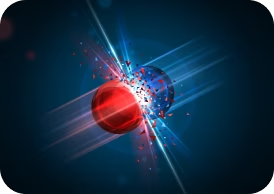
Physical and nuclear reaction by which a heavy atomic nucleus (such as Uranium) divides into two or more lighter nuclei, releasing a colossal amount of energy. Theorized by Lise Meitner.
Matilda Effect
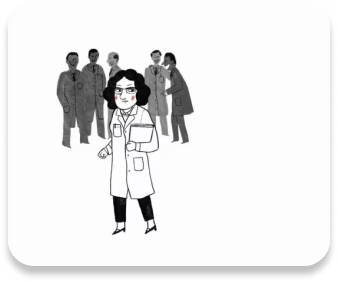
Historical and sociological bias that leads to denying, minimizing or attributing to male colleagues the contributions of women scientists.
Neutron
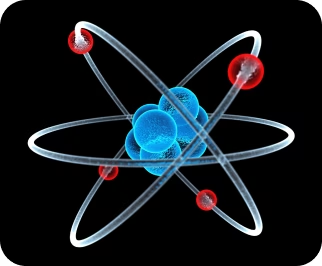
Subatomic particle, without electrical charge (neutral), located in the nucleus of the atom. The bombardment of heavy nuclei by neutrons is at the origin of fission.
Parity Non-conservation
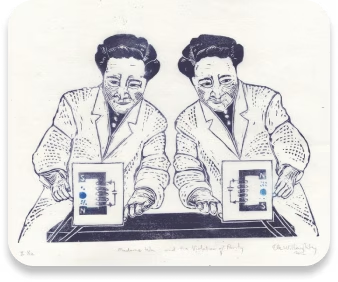
Principle of particle physics discovered by Chien-Shiung Wu, showing that the laws of nature are not necessarily symmetrical for a phenomenon and its image in a mirror (violating a supposed fundamental symmetry).
Manhattan Project
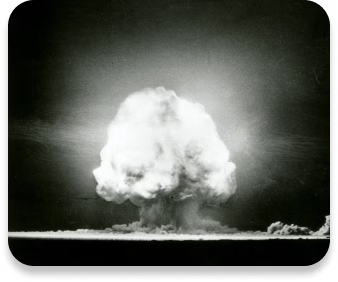
Code name for the research project conducted by the United States during World War II, which led to the development of the atomic bomb (a weapon based on nuclear fission).
Radioactivity
Phenomenon by which unstable atomic nuclei disintegrate (transform spontaneously) by emitting radiation (such as those studied by Marie Curie and Lise Meitner).